Art Therapy In Recovery Works When Words Aren’t Enough
Art therapy in recovery is a way for people to express themselves without having to identify exactly what they’re feeling. It’s an important first step for healing and long term sobriety. Here’s what we mean. A woman sits in her first group session, three weeks sober, when the counselor asks how she’s feeling. She opens her mouth and nothing comes. Not because she’s hiding something. Because she truly doesn’t have the words. There’s a knot in her chest she couldn’t name if her life depended on it.
Later that week, someone hands her a piece of paper and some oil pastels and tells her to just make marks. No plan, no talking. She draws a tangle of dark lines with one thin streak of red running through it. She looks at it and, for the first time, something in the knot loosens.
That’s the whole idea behind art therapy. Some of what hurts us lives underneath language, and sometimes you have to go in through a different door.
Art Therapy In Recovery Opens A New Pathway For Feelings
We treat talking as the obvious way to deal with hard feelings. For a lot of people, it is. But talk therapy asks you to do the one thing that trauma, shame, and grief often make impossible, which is to put the worst of it into clear words.
If you grew up learning to keep feelings locked down, or if what happened to you is tangled up in fear, the words just aren’t there yet. You go blank. You say “I’m fine” because the real answer has no shape.
This matters in recovery because substances are often doing a job. They numb something a person can’t face head-on. If you can’t get to that something, it keeps driving the wheel.
What Is Art Therapy In Recovery
Let’s clear up the biggest myth first. Art therapy is not an art class, and it has nothing to do with talent. Nobody grades your drawing. You can make stick figures or smear color around like a kid, and it works just the same.
A trained art therapist guides the process. You make something, and then, if you want, you talk about what came up while you were making it. The image becomes a starting point. It’s easier to say “this dark part in the corner is how mornings feel” than to explain the whole thing cold.
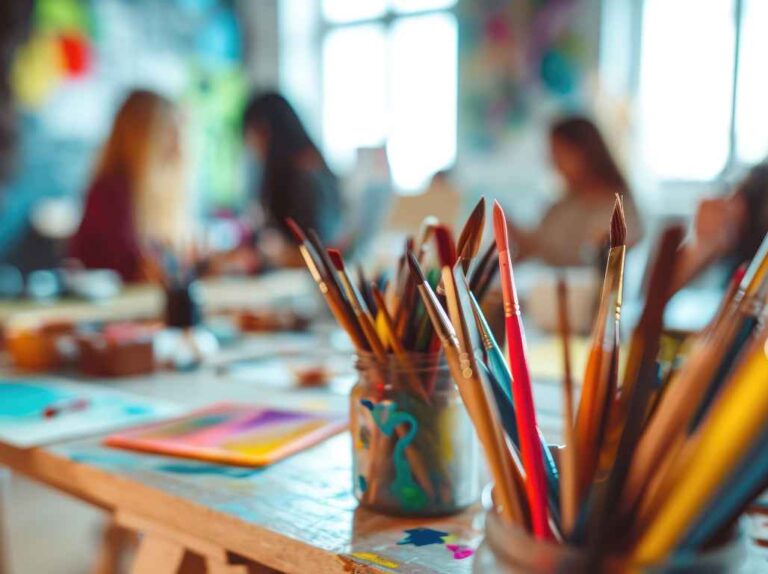
The making itself does something too. Working with your hands, focusing on color and shape, tends to quiet the mental noise. People often relax without meaning to. It can look as simple as tearing paper into a collage, shaping clay until your shoulders drop, or filling a page with one color because that’s the only color that feels true that day.
What Does The Research Show About Art Therapy In Recovery
The evidence here is growing, and it’s worth being straight about what it does and doesn’t show.
A 2026 systematic review in the Journal of Psychiatric and Mental Health Nursing pooled 14 studies with 861 adults and found that art therapy was linked to a moderate reduction in symptoms of depression. The same review found the effect on anxiety was less clear, so this isn’t a cure-all. It’s one useful tool among several.
There’s also something measurable happening in the body. A 2016 study in the journal Art Therapy found that just 45 minutes of making art lowered levels of cortisol, a stress hormone, in most people who took part, whether or not they had any art background. You don’t have to believe art is magic. Your nervous system responds to it either way.
Why Does Art Therapy In Recovery Work So Well
Addiction rarely travels alone. According to SAMHSA’s 2024 National Survey on Drug Use and Health, about 46% of adults with a substance use disorder also had a mental illness that year. Underneath a lot of substance use is depression, anxiety, or old trauma that never got dealt with.
Art therapy reaches that underneath. It gives people a way to look at painful things at a slight angle, through an image instead of head-on, which can feel safer than being asked to relive it out loud. That’s why so many treatment centers now fold it in alongside regular counseling, and why it often sits next to other hands-on approaches like music, movement, or working with animals.
If you’re looking into treatment, it’s reasonable to ask what a program offers beyond talk therapy. A treatment center that includes creative therapies can give you more than one way in, which matters a lot when words are the exact thing you’re struggling with.
When Should I Seek Help For Addiction and How
Art therapy is a complement, not a replacement for real treatment. If you or someone you love is leaning on alcohol or drugs to cope, or sinking under depression or anxiety, the first move is a proper assessment with a professional.
You can start with your primary care doctor, call the behavioral health number on your insurance card, or reach out to a treatment center directly and ask what kinds of therapy they offer. If art therapy interests you specifically, ask whether they have a credentialed art therapist on staff, since that training is what separates real therapy from a craft hour.
If you’re having thoughts of hurting yourself, call or text 988 in the U.S. It’s free and staffed around the clock.
Go back to that tangle of dark lines with the streak of red. The woman who drew it couldn’t have told you what it meant in words, not that day. But she could point at it. And pointing turned out to be enough to start. Sometimes healing doesn’t begin with the right thing said. It begins with something finally shown.
More Articles To Read About Recovery
Supporting Loved Ones Through Challenges
7-Tip Family Support Guide For Detox Withdrawal
Vagus Nerve Stimulation Questions and Answers
9 Tips To Help A Loved One’s Recovery Journey
Dealing With Addiction Issues: Why You Should Go To A Rehab
Tips To Celebrate Milestones In Recovery
Article Sources
- Qiao Y, et al. (2026). The Effectiveness of Art Therapy on Adults With Depression: A Systematic Review and Meta-Analysis. Journal of Psychiatric and Mental Health Nursing — https://onlinelibrary.wiley.com/doi/abs/10.1111/jpm.70127 [VERIFY: confirm full author list before publishing]
- Kaimal G, Ray K, Muniz J (2016). Reduction of Cortisol Levels and Participants’ Responses Following Art Making. Art Therapy, 33(2), 74–80 — https://www.tandfonline.com/doi/abs/10.1080/07421656.2016.1166832
- Substance Abuse and Mental Health Services Administration (SAMHSA), 2024 National Survey on Drug Use and Health (co-occurring mental illness and substance use disorder) — https://www.samhsa.gov/blog/release-2024-nsduh-leveraging-latest-substance-use-mental-health-data-make-america-healthy-again